Hotel Infinity Production Development Blog
Guiding Design Decisions through Playtesting
This past November, my team at Studio Chyr and I launched Hotel Infinity, a multi-platform VR game and partner title for Meta Quest and Sony.
Hotel Infinity is, first and foremost, a roomscale exploration game. While we built out the game with an alternative locomotion system (to accommodate players without a 2m x 2m playspace and with accessibility needs), the game was fundamentally designed for roomscale locomotion. The game’s premise is to evoke in the player the feeling of exploring a limitless, infinite hotel, from walking long swaths of empty hallways down to the tactility of operating the Keurig and toaster at the bed and breakfast.
Consequently, one of the biggest design challenges we faced was balancing puzzle-solving with traversal. We observed in our internal team playtests that long, uninterrupted walking sequences always became boring eventually, no matter how many interesting environment setpieces were sequenced together. Conversely, getting stuck on an overly intricate and complicated puzzle wasn’t much fun either.
Both of these design issues were exacerbated by a larger, more intrinsic problem. Hotel Infinity involves lots of standing, walking, and raising your arms to gesture, grab, and point at in-game objects, all with the weight of the headset on your head. When playtests drew too long, our team started feeling physically tired and uncomfortable, which was a frustrating way to end play sessions and not the takeaway feeling we wanted our players to have.
Our design team’s primary goal was to find balance: creating a finely-tuned sequence of environmental exploration and puzzle-solving that would never overtax or bore the player physically or mentally.
First— the walking.
Up to this point in development, rooms in the game were separated with what we called “infinite walking sequences”— essentially, long stretches of procedurally-generated hallways with duplicated assets the player could walk through.
While the infinite hallways were initially a helpful tool for connecting in-game spaces on the backend, internal playtests showed that they felt far too boring to traverse compared to the bespoke hallway set pieces created by our environment artists. And that boredom made our team members increasingly aware of the discomfort of the headset as they walked.
So, we scrapped infinite walking. And we settled on the design pillar that when the player is walking, exploration should be meaningful, intentional, visually interesting, and provide a break from solving puzzles.
The other side of the issue was tackling puzzle pacing and difficulty. As our main external playtest coordinator at the time, I was tasked with getting more player feedback on the issue.
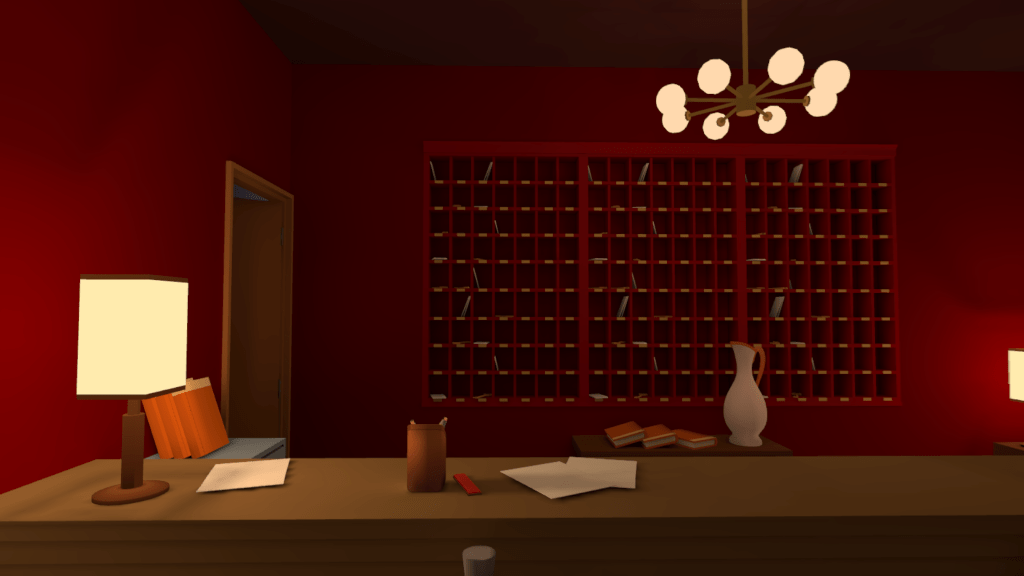
Over the course of a few months, I scheduled and structured playtests with new players to specifically test the flow, pacing, and difficulty of the puzzles in Hotel Infinity’s first chapter. In Chapter 1, the player enters the hotel for the first time, signs in at the front desk, rides an elevator up to their room, and proceeds to the atrium. This opening sequence is arguably one of the most visually dynamic and a moment of extreme narrative importance, so we really wanted this section to hit the nail on the head.
For each playtest, I followed the same method. I would have the players load up Chapter 1 from the main menu and let them play without guidance or extraneous commentary. At each puzzle interaction, I observed their initial thoughts and strategies and listened as they narrated their impressions and thought processes as they attempted to solve the puzzle. I took note of which puzzles players breezed past, which ones players struggled with, and what aspects of the puzzles gave them trouble. I also debriefed with each player afterwards to hear their own opinions on why they struggled or didn’t struggle and what they liked or didn’t like about each puzzle, to supplement the observational feedback.
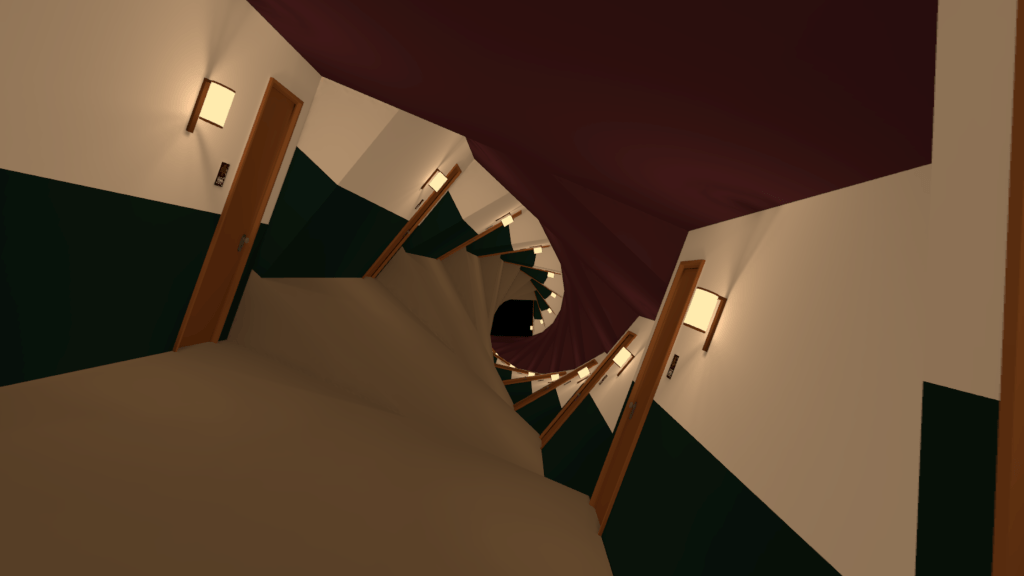
Gradually, I discovered that while a handful of the Chapter 1 puzzles were hitting the mark between being engaging and interesting without putting too much mental strain on the player, some were causing players to get stuck in ways our designers didn’t anticipate. For example, for certain puzzles, players didn’t realize they had solved the puzzle due to insufficient success indicators or environmental changes. Players also attempted to backtrack to find puzzle solutions, whereas we had never designed any of the puzzles with necessary backtracking. Another specific issue was that players frequently got lost in the twists and turns of the upstairs hallways and grew frustrated.
After isolating these trends across multiple playtests, I brought my observations to our design team to discuss solutions. Most ended up being slight tweaks to each puzzle to better hint to the player that they were making progress towards the solution. For the upstairs hallway, we ended up breaking up the section in half. We also added a puzzle that unlocks the door forward as a clear checkpoint to break up the monotony of the walking.
I tested the improved Chapter 1 puzzle designs on our next group of playtesters and found increasingly positive results. As we had hoped, players weren’t getting stuck on puzzles as often, nor in the hallway maze sequence, and reported that the flow and pacing for Chapter 1 felt comfortable. And, most importantly, players were having fun and completing the chapter without excessive frustration or physical discomfort.
We repeated the process to further refine the sequence. The result of that period of iteration culminated in a solid Chapter 1 sequence that hit our design team’s internal goals of being fun, stimulating, and not too mentally or physically taxing on the player.
It was amazing to see the sequence come together over months of iteration. The experience taught me the importance of playtesting for identifying unforeseen design flaws and guiding design iteration to reach the target player experience.